Optic System
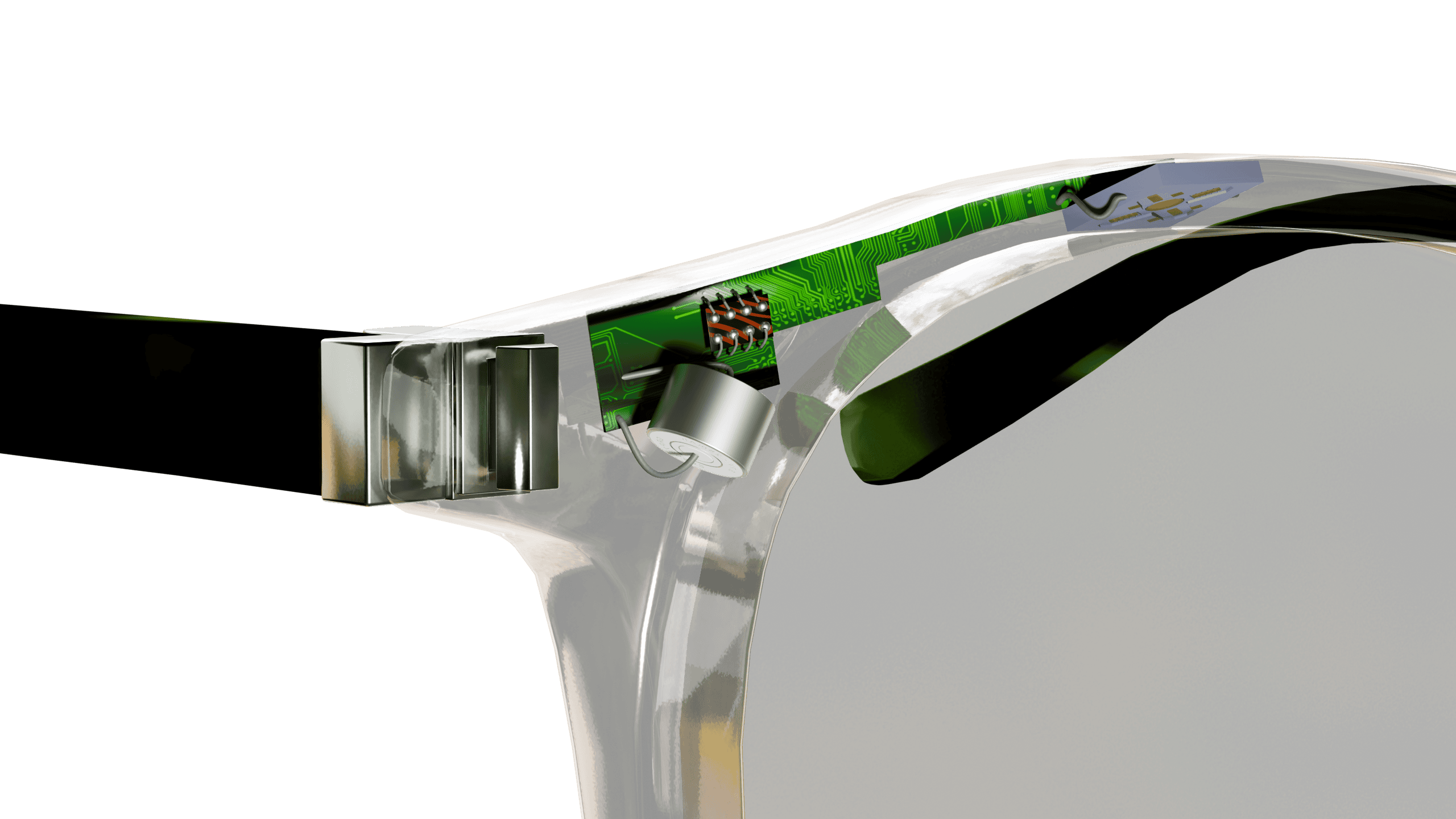
Passive Display Operation
The passive display, as described in the “LED Projection System with Passive MEMS Display” document, is based on the interaction between a MEMS micro-mirror and the light projected by the LED projection system. Here’s how the image reconstruction on the surface of the glasses occurs:
1. Modulated Illumination from the Projector:
The LED projection system emits light from a point source. This source turns on and off at a precise frequency, specifically calibrated according to the resolution of the image to be projected. This modulation of light encodes the spatial information of the image.
2. Two-Dimensional Scanning of the MEMS Micro-Mirror:
The heart of the passive display is a MEMS micro-mirror, integrated into the glasses and positioned at 45°. This micro-mirror performs a rapid and controlled movement in two dimensions. As specified in the document, the micro-mirror rotates, forming a horizontal line and then proceeding vertically to create new lines.
3. Reflection and Line-by-Line Reconstruction:
As the micro-mirror moves horizontally, it reflects the light coming from the projection system. The focal point of the projected light must be smaller than the diameter of the micro-mirror for proper reflection. The intensity of the reflected light at each instant corresponds to the modulation of the LED source at that precise moment, “painting” a portion of the horizontal line of the image.
4. Vertical Advance for Image Formation:
Once the horizontal scan of a line is completed, the micro-mirror moves vertically. This progressive movement allows the entire image area to be scanned, line by line.
5. Visualization on the Reflective Surface of the Glasses:
The light reflected by the micro-mirror is directed towards a reflective surface integrated into the lens of the glasses. As described in the document, this surface is a rectangle of semi-transparent material that acts as a beam splitter, transmitting 50% of the ambient light and reflecting 50% of the projected light towards the user’s eye. Thanks to this mechanism, the image reconstructed line by line by the movement of the micro-mirror is superimposed on the user’s view of the real world.
In summary, the passive display leverages the two-dimensional scanning of a MEMS micro-mirror to modulate the light coming from an external LED projection system. This precise synchronization allows the desired image to be reconstructed on the reflective surface of the glasses, line by line, offering an augmented reality experience. It is crucial to emphasize that, as indicated in the document, the MEMS on the glasses is a passive component that reflects light, unlike other systems that might use active MEMS to generate light.