Overview
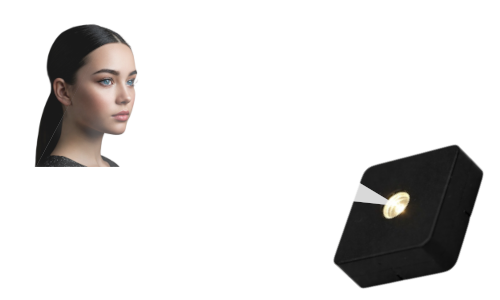
This document details an innovative projection and display system designed for augmented reality (AR) applications, utilizing a MEMS and optical system to project images onto the surface of glasses. The system is composed of two main components:
- LED Projection System: A projection system that uses a light source that is rapidly turned on and off.
- Passive Display and Optics: An optical system that manipulates the light from the projection system to create the final image.
1. LED Projection System
The LED projection system is responsible for generating the light that will form the image.
1.1 MCU (Microcontroller Unit)
- The MCU controls the laser diode, determining when it should be turned on or off. In color displays, it also manages the different colors.
- Each laser pulse creates a light spot (pixel) on the passive display. The microcontroller forms the image by controlling the laser, turning the diode on/off or managing colors (RGB) and their combinations for color displays.
1.2 LED Diode
- The LED diode emits the light which, after being reflected through the optical components, forms the final image.
- The light is modulated by the MCU, which controls the on/off state of the LED.
1.3 Resolution and Refresh Rate Considerations
- Since the system projects one pixel at a time, the LED frequency must be sufficiently high to support the desired resolution and refresh rate.
- Examples of common resolutions and their corresponding minimum LED frequencies (assuming a minimum refresh rate of 24Hz):
- HD (1280x720 pixels): > 1280 * 720 * 24 Hz = > 22,118,400 Hz (22.1 MHz)
- Full HD (1920x1080 pixels): > 1920 * 1080 * 24 Hz = > 49,766,400 Hz (49.8 MHz)
- 4K (3840x2160 pixels): > 3840 * 2160 * 24 Hz = > 199,065,600 Hz (199 MHz)
- Formula: Horizontal Pixels * Vertical Pixels * Refresh Rate
- It is important to note that these are minimum frequencies. For a smooth viewing experience and to reduce flickering, it is advisable to use higher frequencies.
2. Passive Display and Optics
The passive display and optics component receives light from the projection system and manipulates it to form the image visible to the user.